
Semiconductor Integrated Quantum Optical Network (SemIQON)
Motivation
Quantum entanglement of light signals and their efficient distribution over great distances is essential for future global quantum networks. Single photons are a prime candidate for "flying" qubits, i.e. qubits which are suitable for the transmission of quantum information between network nodes. A promising source of entangled single photons are semiconductor quantum dots, which allow integration into miniaturized electronic and photonic cirquits. A combination with micro-electromechanical systems (MEMS) enables dynamic tuning of the relevant optical parameters, and therefore of the quantum mechanical properties of those single photons.
Goals and procedure

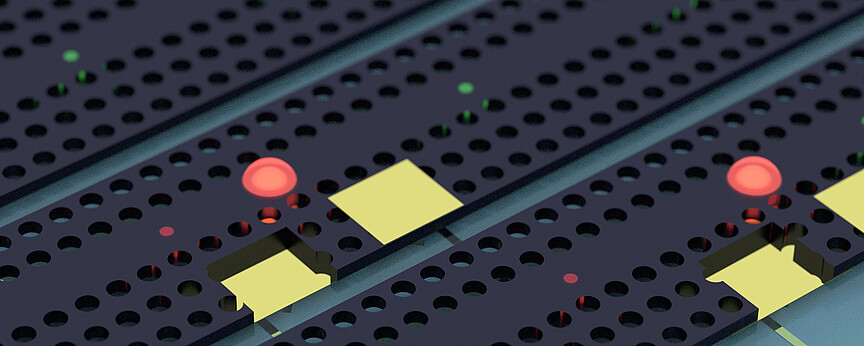
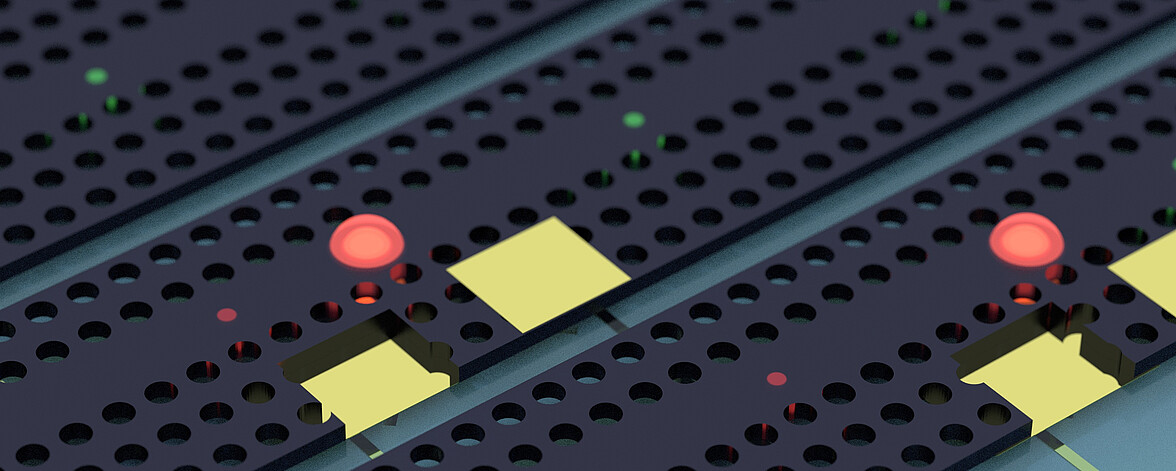
The goal of this project is the development of a (hybrid) semiconductor MEMS building element for scalable applications in optical quantum repeaters and quantum computers. This element will contain a nanophotonic network of quasi-identical, entangled semiconductor quantum dots. This will unlock efficient generation of many-qubit entangled states, both between photons and quantum dots. During development, multiple key technologies will be involved and connected, like semiconductor nanostructures and diodes, photonic circuits, and piezoelectronic microstructures.
Innovation and perspectives
Modern manufacturing technologies enable the operation of many semiconductor systems on one chip in parallel. With semiconductor quantum dots, high data rates (up to GHz) are achievable with respect to the generation of a large number of entangled photons.
This opens up new possibilities in topological photonics, which exploits the specific link between the structure of a device and its refractive properties. Also, in perspective, neuromorphic quantum computing research could benefit from the pursued approach. Quantum dots can be developed for emission in the telecommunication wavelength range and used in quantum communication.